
Audio to Video AI: Why Kinetic Typography is the Future of Long-Form Content
In the 2025 digital landscape, 98% of businesses report that video is an essential marketing tool. Yet, most podcasters and thinkers still share static audio links or basic waveforms that are invisible on silent-by-default social feeds. To capture attention today, you don't just need a "video"; you need a high-retention engine that forces your audience to engage.
1. The Death of the "Static" Audiogram
Standard audiograms—a moving line over a still image—are no longer sufficient. Modern audiences demand "Simple Motion Text," a 2025 trend that prioritizes minimalist, punchy typography over chaotic edits.
- Visual Dominance: 90% of information transmitted to the brain is visual.
- Social Reality: Most social media users scroll with sound off.
- The Solution: Kinetic typography transforms invisible audio into an active reading experience.
2. The Science of Dual Coding: Why Text Videos Win
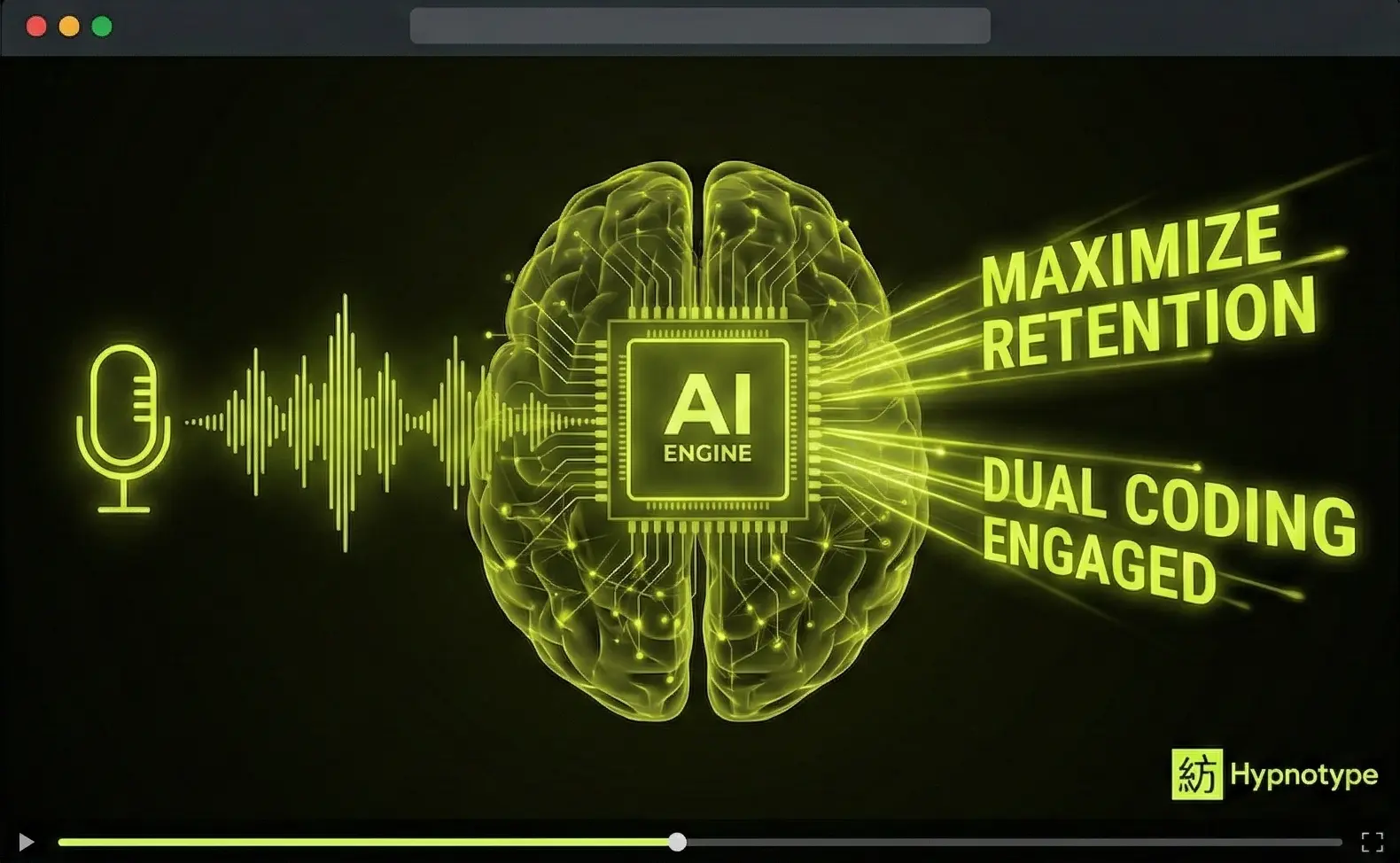
The effectiveness of Audio to Video AI is rooted in "Dual Coding Theory." This cognitive science principle suggests that the brain processes verbal and visual information through two distinct channels.
- Retention: Synchronizing word-level animations with a voiceover forces the viewer to "read-listen" simultaneously.
- Cognitive Load: When text and audio are perfectly synced, it reduces the mental effort required to process the message, leading to higher retention rates.
- Precision Sync: Tools like Hypnotype use OpenAI Whisper to achieve frame-perfect word timing, ensuring this "hypnotic" effect is never broken by lag.
3. The Problem with Legacy Video Editors
Many creators attempt to use professional suites or "all-in-one" AI tools, but these often fail due to "feature creep".
- Descript & High-End Tools: While powerful, these platforms can be overwhelming and suffer from performance issues on longer files.
- After Effects: Creating kinetic typography manually requires hours of work for a single minute of video.
- The Hypnotype Advantage: By focusing solely on a streamlined typography workflow, creators can move from raw audio to a finished export in under 10 minutes.
4. How to Implement an "Audio to Video" Strategy
To maximize the reach of your ideas, your content should follow a specialized workflow designed for thinkers, not just "entertainers":
- Audio Upload: Drop your podcast or VSL script. Benefit: Instant transcription via AI.
- Style Selection: Choose a minimalist, high-contrast template. Benefit: Forces focus on the message, not the "fluff".
- Cloud Render: Generate an MP4 via server-side rendering. Benefit: No drain on your local device resources.
Conclusion: Stop Being Invisible
If your content relies on the quality of your ideas, you cannot afford to hide them behind a play button on a static page. Kinetic Typography is the "Founders" aesthetic—a brutalist, clear, and disruptive way to signal depth in a sea of shallow content.